


The AI Buildout Is Reshaping Global Trade

Dr. Jeffrey Roach

Jeffrey Roach guides the overall view of the economy for LPL Financial Research and has over 20 years of experience in investing and economics.

November 05, 2026

The artificial intelligence (AI) investment boom is beginning to leave a clear imprint on U.S. trade, computer inflation, and the labor market as highlighted in our recent Econ Market Minute.


The trade deficit subtracted 3.3 percentage points from Q3 economic growth. Excluding “Liberation Day” distortions, last quarter’s negative impact was the largest since 1947!


In this piece, I explain why the trade deficit has widened so dramatically. American technology companies are pouring capital into data centers and computing capacity, but much of the physical equipment needed to build that infrastructure is produced abroad. Servers, semiconductors, storage systems, networking equipment, and other advanced electronics are increasingly flowing into the U.S., creating an unusual dynamic: an investment boom largely driven by American companies is becoming an important source of demand for manufacturers outside the U.S.


AI has become one of international trade’s principal drivers. And this happened despite formidable trade barriers. The average U.S. tariff rate rose from 2.9% in January 2025 to 14.8% by December. Dallas Federal Reserve (Fed) researchers estimate that, all else equal, the increase in tariffs would have reduced U.S. imports by approximately 12%. Some of the resilience reflected companies rushing imports ahead of tariffs, but booming AI investment was another important counterweight. Demand for computing equipment has simply been strong enough to overcome some of the drag from substantially higher trade barriers.


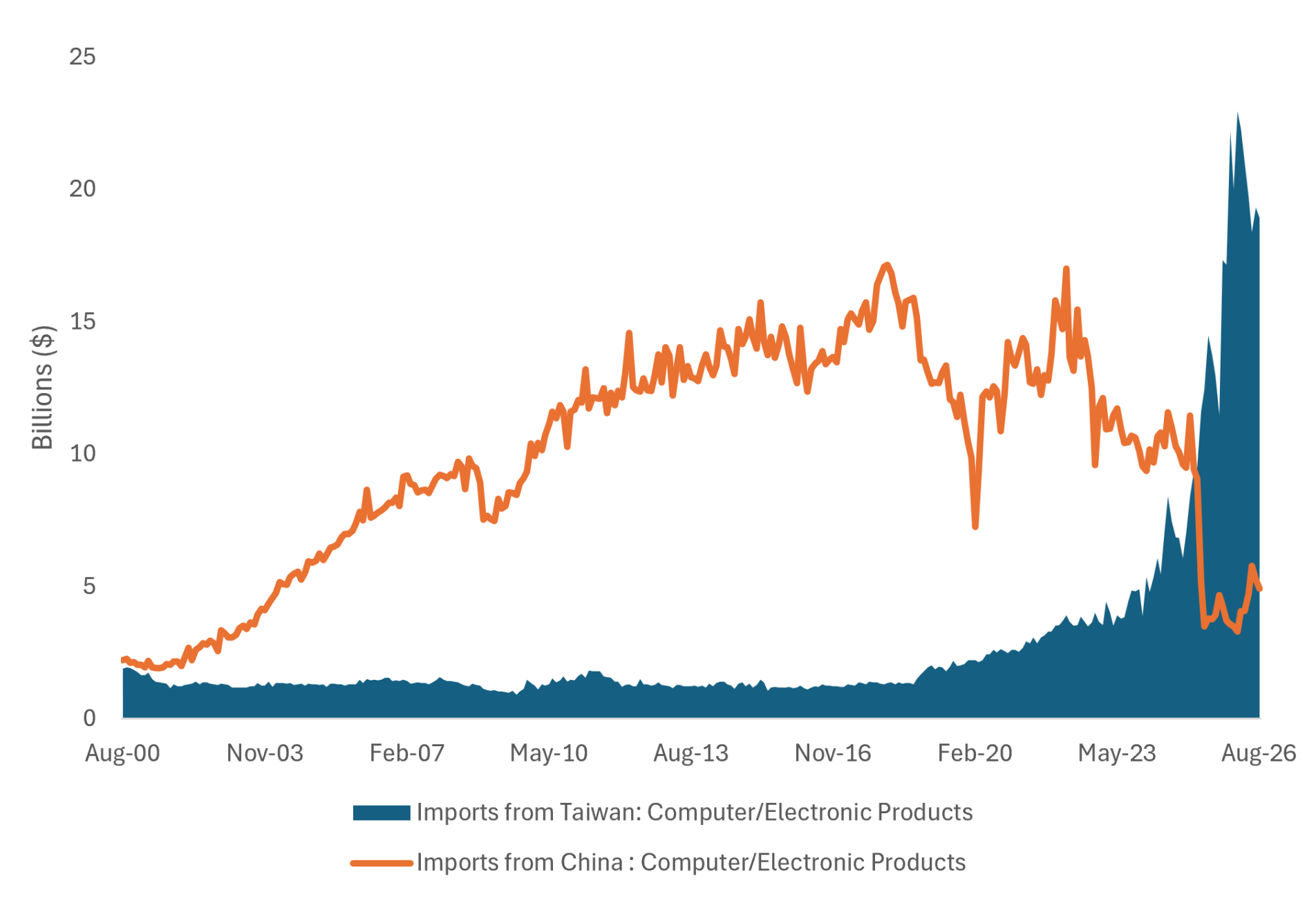
The AI Buildout is Drastically Reshaping International Trade

Source: LPL Research, Census Bureau 11/04/26

Disclosures: Past performance is no guarantee of future results.


The AI boom is also changing where America buys its goods. China's share of U.S. imports fell from 13.4% in 2024 to 9% in 2025, while countries including Taiwan, Mexico, Vietnam, and India gained ground. Growth in technology imports from Taiwan and Mexico has substantially exceeded the decline from China, suggesting the pattern reflects more than a simple reshuffling of existing trade. It represents new demand alongside the reorientation of global supply chains.


Taiwan occupies a particularly important position because of its role in advanced semiconductors and computing. Mexico's growing role tells a different, but complementary, story. Much of the computing equipment used in U.S. data-center construction has been imported through Mexico, according to the Dallas Fed, reinforcing the country's position inside North America's technology manufacturing hub.


There is even evidence that AI demand is spilling into prices. Heavy demand for memory chips used in data centers has helped push consumer-electronics prices higher, reversing their decades-long tendency to decline. That underscores the scale of the investment cycle: AI infrastructure is competing for some of the same technology components used elsewhere in the economy.


The International Investment Angle


For investors, these changing trade patterns broaden the AI story beyond the familiar group of U.S. technology companies. American hyperscalers may be writing many of the checks for new data centers, but an expanding portion of the manufacturers are overseas.


That creates an important argument for international diversification that goes beyond cheaper valuations. Taiwan offers exposure to semiconductors and advanced-computing supply chains. Mexico is becoming more deeply integrated into North American technology manufacturing. Vietnam, India, and other Asian economies are gaining share as global supply chains continue to diversify away from China.


There is an interesting macroeconomic twist. Imports subtract from U.S. gross domestic product (GDP) accounting, so the AI infrastructure boom can widen the trade deficit and weigh down U.S. growth even while signaling strong underlying business investment. At the same time, American investment can support production, capital spending and incomes in countries supplying the equipment.


For investors heavily concentrated in U.S. equities, that is worth considering. AI may be led, and financed by America, but the economic benefits are increasingly global. The next stage of the AI investment cycle may create opportunities not only among the companies designing models and operating data centers, but also among the international companies and economies supplying the semiconductors and electronics needed.


Important Disclosures


This material is for general information only and is not intended to provide specific advice or recommendations for any individual. There is no assurance that the views or strategies discussed are suitable for all investors. To determine which investment(s) may be appropriate for you, please consult your financial professional prior to investing.


Investing involves risks including possible loss of principal. No investment strategy or risk management technique can guarantee return or eliminate risk.


Indexes are unmanaged and cannot be invested into directly. Index performance is not indicative of the performance of any investment and does not reflect fees, expenses, or sales charges. All performance referenced is historical and is no guarantee of future results.


This material was prepared by LPL Financial, LLC. All information is believed to be from reliable sources; however LPL Financial makes no representation as to its completeness or accuracy.


Unless otherwise stated LPL Financial and the third party persons and firms mentioned are not affiliates of each other and make no representation with respect to each other. Any company names noted herein are for educational purposes only and not an indication of trading intent or a solicitation of their products or services.


Asset Class Disclosures –


International investing involves special risks such as currency fluctuation and political instability and may not be suitable for all investors. These risks are often heightened for investments in emerging markets.


Bonds are subject to market and interest rate risk if sold prior to maturity.


Municipal bonds are subject and market and interest rate risk and potentially capital gains tax if sold prior to maturity. Interest income may be subject to the alternative minimum tax. Municipal bonds are federally tax-free but other state and local taxes may apply.


Preferred stock dividends are paid at the discretion of the issuing company. Preferred stocks are subject to interest rate and credit risk. They may be subject to a call features.


Alternative investments may not be suitable for all investors and involve special risks such as leveraging the investment, potential adverse market forces, regulatory changes and potentially illiquidity. The strategies employed in the management of alternative investments may accelerate the velocity of potential losses.


Mortgage backed securities are subject to credit, default, prepayment, extension, market and interest rate risk.


High yield/junk bonds (grade BB or below) are below investment grade securities, and are subject to higher interest rate, credit, and liquidity risks than those graded BBB and above. They generally should be part of a diversified portfolio for sophisticated investors.


Precious metal investing involves greater fluctuation and potential for losses.


The fast price swings of commodities will result in significant volatility in an investor's holdings.


This research material has been prepared by LPL Financial LLC.


Not Insured by FDIC/NCUA or Any Other Government Agency | Not Bank/Credit Union Deposits or Obligations | Not Bank/Credit Union Guaranteed | May Lose Value


For Public Use – Tracking: #1204311

By Jeff Buchbinder | Chief Equity Strategist • November 4, 2026
Jeff Buchbinder Jeff Buchbinder, CFA, provides the top-down view of the stock market for LPL Financial Research. He has over 25 years of experience in equities. November 04, 2026
Stacks of coins with glowing percentage symbols, suggesting interest or growth in finance
By Melanie Weischwill | Partner & Financial Advisor • September 2, 2026
With the November midterm election approaching, campaigns are starting to intensify across the country.

Blue financial chart with glowing line graph and data overlays on a digital screen
By Jayce Serrano | Financial Advisor • September 1, 2026
The stock market has climbed to new all-time highs following several periods of uncertainty this year.

Close-up of coins with white percent symbols, suggesting interest or finance
By Caleb Staudt, CPFA | Partner & Financial Advisor • September 1, 2026
Since new tariffs were announced last year, global trade has been a source of uncertainty for financial markets and the economy.

Person working at a laptop with printed charts and graphs on a desk, in an office setting
By Adam Turnquist | Chief Technical Strategist • August 25, 2026
Adam Turnquist | Chief Technical Strategist  Last Updated: August 25, 2026

Hands using a calculator over financial charts and spreadsheets on a desk
By Dr. Jeffrey Roach | Chief Economist • August 20, 2026
Dr. Jeffrey Roach | Chief Economist  Last Updated: August 20, 2026

Hands pointing at a laptop displaying charts and graphs during a business meeting
July 9, 2026
Melanie Weischwill | Partner & Financial Advisor  July 8, 2026

Hand using a transparent AI interface above a tablet on a wooden table
July 9, 2026
Greg Iacurci@GregIacurci | Personal Finance Reporter  Published Tue, Jul 7 202612:21 PM EDT Key Points A new study in the Journal of Financial Planning found that artificial intelligence programs can provide inconsistent, inaccurate or biased recommendations when it comes to personal finance. Researchers prompted seven AI programs — ChatGPT, Claude, Copilot, DeepSeek, Gemini, Meta AI and Perplexity — with questions about emergency savings, asset allocation and withdrawals from a retirement portfolio. The findings align with those of other experts, who recommend using AI as a starting point for financial questions but not as a final authority. When it comes to personal finance, artificial intelligence gives advice that can be inaccurate or demographically biased, and can range widely depending on the particular program that consumers use, according to a new academic research study. The research — which studied seven “widely available” generative AI platforms — found “significant variation” in how GenAI answered prompts about emergency savings, asset allocation and withdrawals from a retirement portfolio. Researchers examined free-access versions of ChatGPT, Claude, Copilot, DeepSeek, Gemini, Meta AI and Perplexity. “GenAI-driven responses may sound confident but can still be incomplete, misleading, or incorrect,” according to the paper, published last month in the Journal of Financial Planning and authored by finance professors at the University of Georgia and University of Rome Tor Vergata in Italy. Its “suboptimal” or biased outputs raise questions “about the consistency and fairness of GenAI-driven recommendations,” according to authors Swarn Chatterjee, Brenda Cude and Gianni Nicolini. The findings come as a large share of Americans are turning to AI to help manage their money. Two out of three Americans — 66% — who have used GenAI said they’ve leveraged it for financial advice, according to an Intuit Credit Karma survey published in September. The share is higher for Gen Z and millennials, at 82% for each cohort. Experts said that AI is generally good at providing high-level overviews of financial topics: For example, why it’s important to diversify investments, or why exchange-traded funds may be better than mutual funds in some cases but not others. However, it has limitations that mean users shouldn’t trust its output blindly, they said. For one, the programs can also provide wrong answers due to so-called “hallucination” of the algorithm, experts said. “One of the things about LLMs that I find particularly concerning is that no matter what you ask it, it’ll always come back with an answer that sounds authoritative, even if it’s not,” Andrew Lo, director of MIT’s Laboratory for Financial Engineering and principal investigator at its Computer Science and Artificial Intelligence Lab, told CNBC in an interview in March. “When it comes to very, very specific calculations of your own personal situation, that’s where you have to be very, very careful,” Lo said. In addition, AI is sensitive to how users write their prompts, meaning small differences in input can lead to variation in its recommendations. AI also doesn’t owe a fiduciary duty to users, meaning it doesn’t legally need to provide financial advice in users’ best interests. Other research studies have also pointed to the limitations of AI for personal finance. In one 2024 study, for example, researchers examined ChatGPT’s ability to provide financial advice. They found it could be a “first stop” for households seeking financial advice, but ultimately found its recommendations to be “generic,” often overlooking certain pertinent information. “We believe that ChatGPT can serve as a starting point in giving and finding financial advice, but its recommendations should be carefully scrutinized and assessed,” according to the study, published in the Journal of Risk and Financial Management. The latest study, in the Journal of Financial Planning, queried the seven GenAI platforms in August 2025 with the same set of prompts. Researchers prompted the platforms with three identical financial scenarios, related to emergency savings, the optimal withdrawal rate from retirement savings and the recommended composition of an investment portfolio. They then used the same prompts, but changed the race and gender of the hypothetical individual to learn if the GenAI recommendations would change. They found “substantial variation in guidance” across platforms relative to emergency savings and asset allocation. “Although the tools often produced recommendations that broadly aligned with generic financial planning principles, such as the 4 percent retirement withdrawal rule, there were significant differences across platforms in suggested emergency savings and portfolio allocations,” researchers wrote. “The findings suggest that GenAl may serve as a helpful starting point for consumers but should complement, not replace, professional financial advice,” they said. Of course, GenAI tools are “still evolving,” and future studies may find different results, they said. And, outputs from the paid GenAI models may differ from those of the free versions that were assessed. Securities and advisory services offered through LPL Financial, a registered investment advisor. Member FINRA/SIPC. CNBC, South Star Wealth Management and LPL Financial are separate entities.

Oil pumpjack silhouetted at sunset under a cloudy sky.
June 9, 2026
Kristian Kerr | Head of Macro Strategy Last Updated: June 04, 2026
Show More