
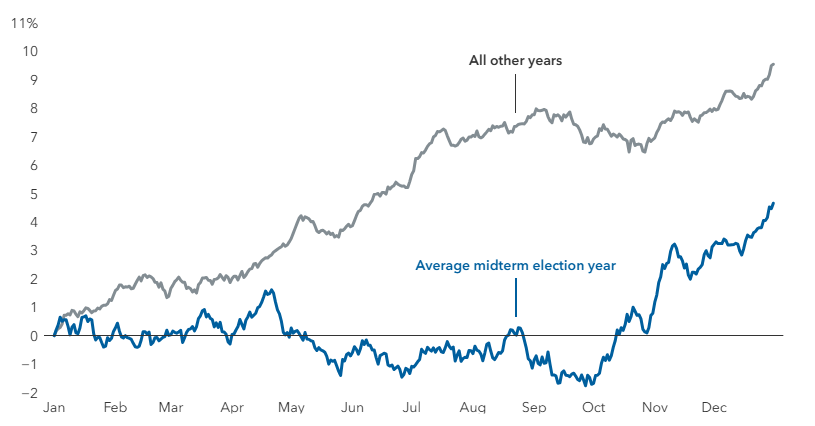
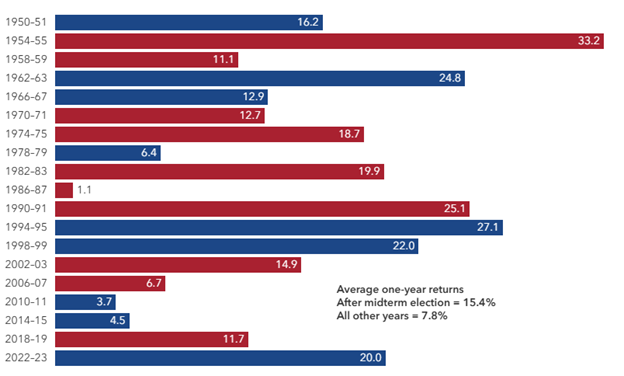
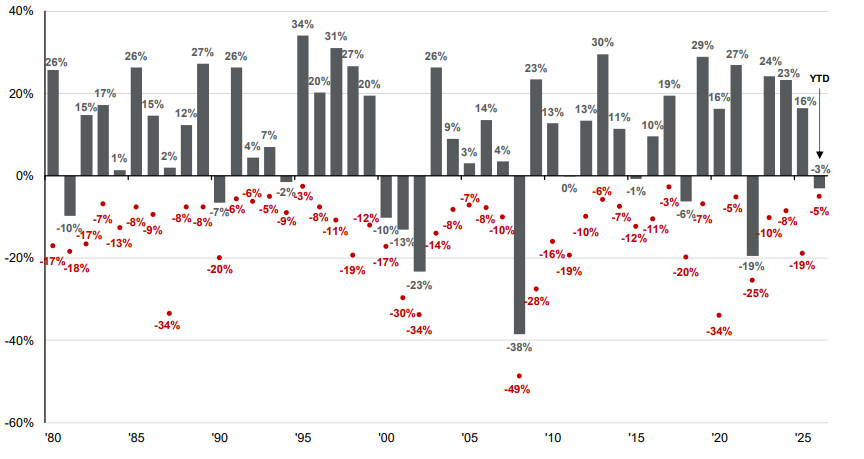

With the November midterm election approaching, campaigns are starting to intensify across the country.

The stock market has climbed to new all-time highs following several periods of uncertainty this year.

Since new tariffs were announced last year, global trade has been a source of uncertainty for financial markets and the economy.

Adam Turnquist | Chief Technical Strategist Last Updated: August 25, 2026


Dr. Jeffrey Roach | Chief Economist Last Updated: August 20, 2026

Melanie Weischwill | Partner & Financial Advisor July 8, 2026

Greg Iacurci@GregIacurci | Personal Finance Reporter Published Tue, Jul 7 202612:21 PM EDT Key Points A new study in the Journal of Financial Planning found that artificial intelligence programs can provide inconsistent, inaccurate or biased recommendations when it comes to personal finance. Researchers prompted seven AI programs — ChatGPT, Claude, Copilot, DeepSeek, Gemini, Meta AI and Perplexity — with questions about emergency savings, asset allocation and withdrawals from a retirement portfolio. The findings align with those of other experts, who recommend using AI as a starting point for financial questions but not as a final authority. When it comes to personal finance, artificial intelligence gives advice that can be inaccurate or demographically biased, and can range widely depending on the particular program that consumers use, according to a new academic research study. The research — which studied seven “widely available” generative AI platforms — found “significant variation” in how GenAI answered prompts about emergency savings, asset allocation and withdrawals from a retirement portfolio. Researchers examined free-access versions of ChatGPT, Claude, Copilot, DeepSeek, Gemini, Meta AI and Perplexity. “GenAI-driven responses may sound confident but can still be incomplete, misleading, or incorrect,” according to the paper, published last month in the Journal of Financial Planning and authored by finance professors at the University of Georgia and University of Rome Tor Vergata in Italy. Its “suboptimal” or biased outputs raise questions “about the consistency and fairness of GenAI-driven recommendations,” according to authors Swarn Chatterjee, Brenda Cude and Gianni Nicolini. The findings come as a large share of Americans are turning to AI to help manage their money. Two out of three Americans — 66% — who have used GenAI said they’ve leveraged it for financial advice, according to an Intuit Credit Karma survey published in September. The share is higher for Gen Z and millennials, at 82% for each cohort. Experts said that AI is generally good at providing high-level overviews of financial topics: For example, why it’s important to diversify investments, or why exchange-traded funds may be better than mutual funds in some cases but not others. However, it has limitations that mean users shouldn’t trust its output blindly, they said. For one, the programs can also provide wrong answers due to so-called “hallucination” of the algorithm, experts said. “One of the things about LLMs that I find particularly concerning is that no matter what you ask it, it’ll always come back with an answer that sounds authoritative, even if it’s not,” Andrew Lo, director of MIT’s Laboratory for Financial Engineering and principal investigator at its Computer Science and Artificial Intelligence Lab, told CNBC in an interview in March. “When it comes to very, very specific calculations of your own personal situation, that’s where you have to be very, very careful,” Lo said. In addition, AI is sensitive to how users write their prompts, meaning small differences in input can lead to variation in its recommendations. AI also doesn’t owe a fiduciary duty to users, meaning it doesn’t legally need to provide financial advice in users’ best interests. Other research studies have also pointed to the limitations of AI for personal finance. In one 2024 study, for example, researchers examined ChatGPT’s ability to provide financial advice. They found it could be a “first stop” for households seeking financial advice, but ultimately found its recommendations to be “generic,” often overlooking certain pertinent information. “We believe that ChatGPT can serve as a starting point in giving and finding financial advice, but its recommendations should be carefully scrutinized and assessed,” according to the study, published in the Journal of Risk and Financial Management. The latest study, in the Journal of Financial Planning, queried the seven GenAI platforms in August 2025 with the same set of prompts. Researchers prompted the platforms with three identical financial scenarios, related to emergency savings, the optimal withdrawal rate from retirement savings and the recommended composition of an investment portfolio. They then used the same prompts, but changed the race and gender of the hypothetical individual to learn if the GenAI recommendations would change. They found “substantial variation in guidance” across platforms relative to emergency savings and asset allocation. “Although the tools often produced recommendations that broadly aligned with generic financial planning principles, such as the 4 percent retirement withdrawal rule, there were significant differences across platforms in suggested emergency savings and portfolio allocations,” researchers wrote. “The findings suggest that GenAl may serve as a helpful starting point for consumers but should complement, not replace, professional financial advice,” they said. Of course, GenAI tools are “still evolving,” and future studies may find different results, they said. And, outputs from the paid GenAI models may differ from those of the free versions that were assessed. Securities and advisory services offered through LPL Financial, a registered investment advisor. Member FINRA/SIPC. CNBC, South Star Wealth Management and LPL Financial are separate entities.

Kristian Kerr | Head of Macro Strategy Last Updated: June 04, 2026

Dr. Jeffrey Roach | Chief Economist Last Updated: May 21, 2026